Father Brown: An Introduction
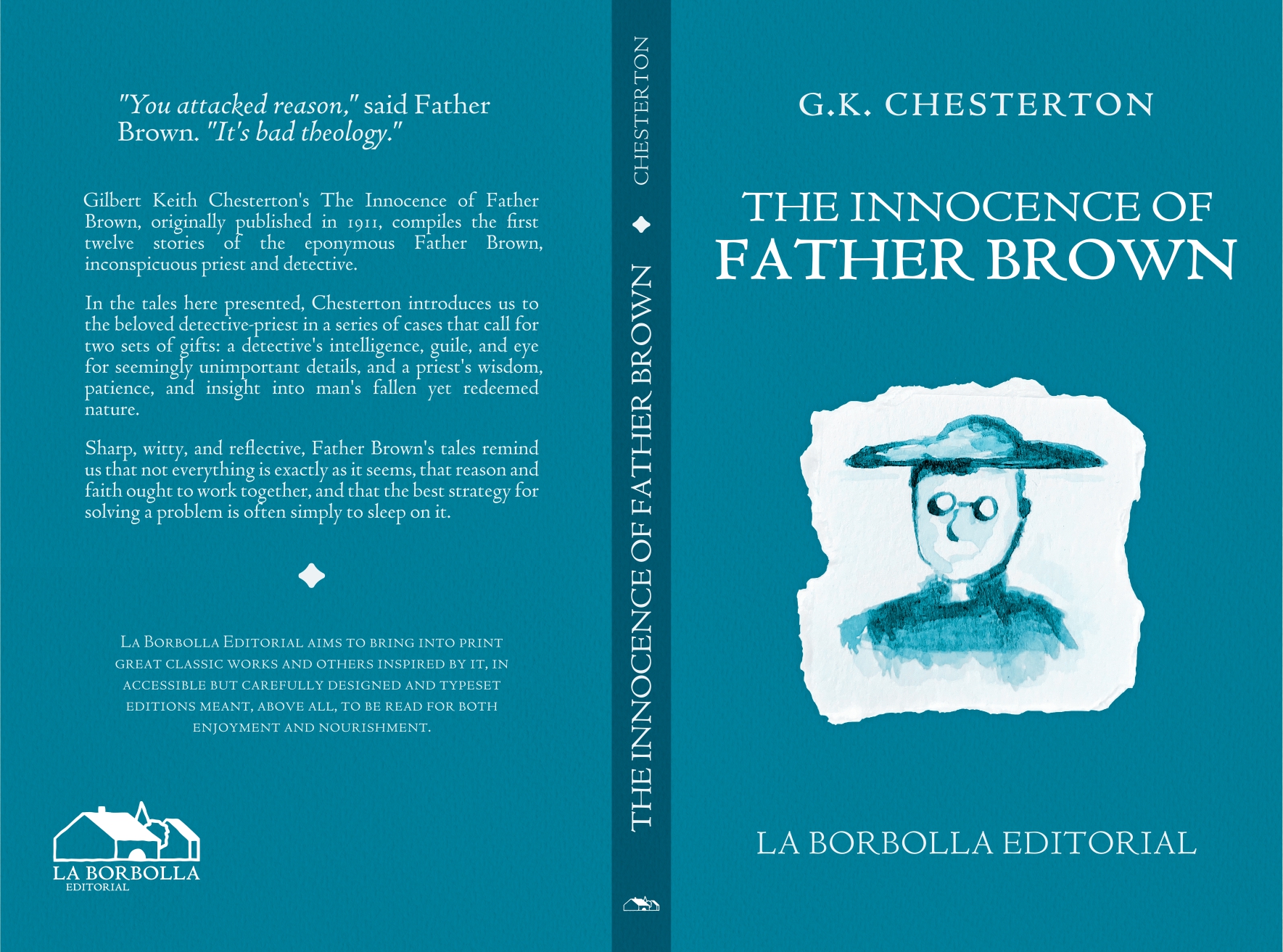
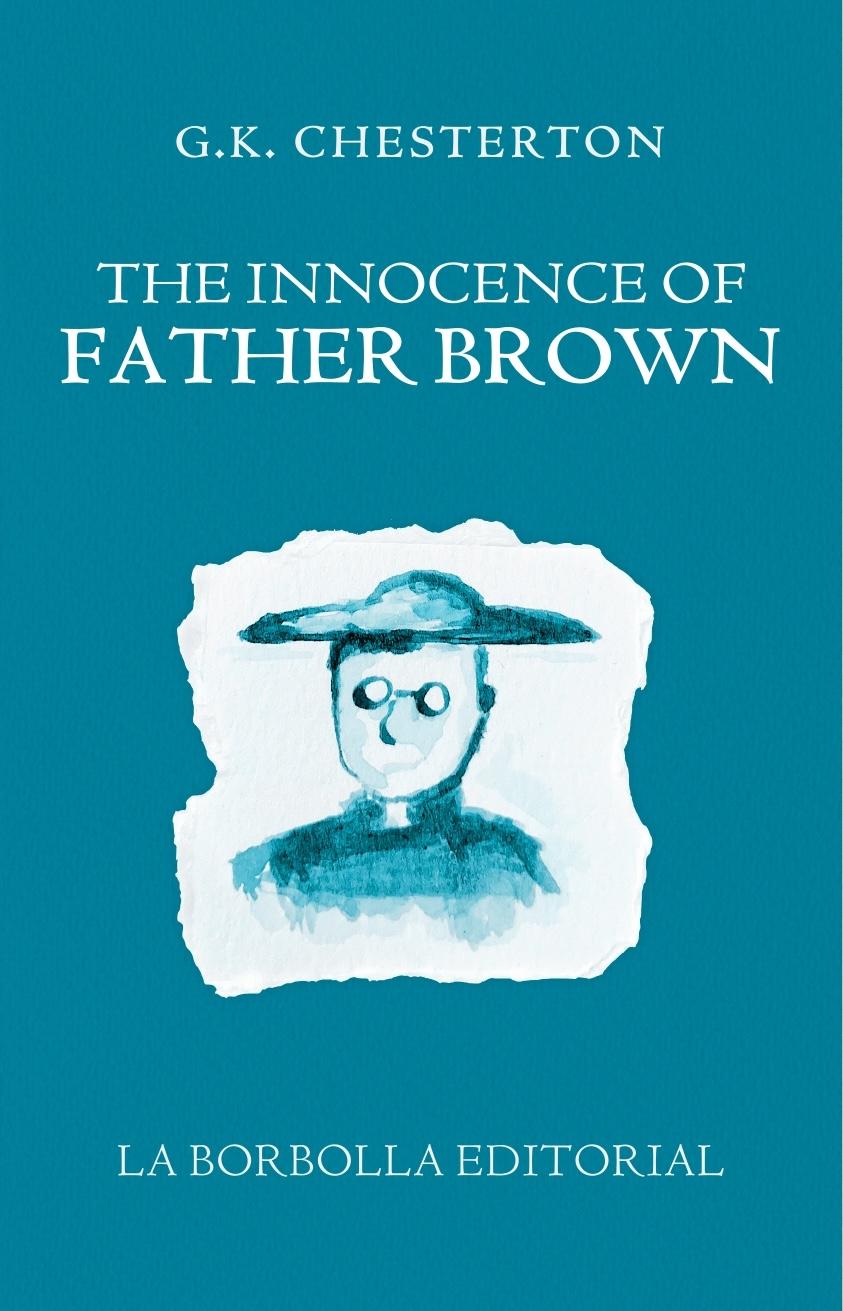
The Innocence of Father Brown
A new edition with an introduction by R.H. Naranjo. Published by La Borbolla Editorial.
Finding the words to describe the enigmatic adventures of Father Brown is no easy task, a common trait shared by the works of G.K. Chesterton. The expected story model from the Golden Age of Detective Fiction is quickly challenged by the nature of the protagonist, the crimes, and the outcomes. Far from being a grand figure like Arthur Conan Doyle’s Sherlock Holmes, Agatha Christie’s Hércules Poirot, or Edgar Allan Poe’s Auguste Dupin, Chesterton’s crime-solving Catholic priest is tiny in every sense of the word. Even the narrator of The Blue Cross forgets about him, focusing instead on the noteworthy Aristide Valentin (an actual detective). After all, why would a short-statured, stout, and unassuming parish priest wearing an ordinary black cassock be out there discovering criminals? The answer is simple: he is not.
To gaze into the imaginative world of Father Brown, the reader cannot ignore Gilbert Keith Chesterton, the man who wrote about almost any topic he came across. A genius with a talent for creative prose, Chesterton loved paradox as a way to deliver a message, and it became one of his most frequent tools. His knowledge of human history, his keen understanding of society, and his British sense of humor make him one of the most unique authors of the twentieth century, and none of his works are lacking when it comes to food for thought. These short stories are not the exception; quite the opposite, they are amongst his most thought-provoking works, if the reader knows where to look.
The fundamental paradox underlying the stories of Father Brown, and one of the most profound despite how evident it may appear at first, is that he solves crimes not by being a detective, but by being a priest. This is, perhaps, one of the most important points of the series, and every story makes the effort to stress it exhaustively. Trained by years of hearing confessions, Father Brown cracks mysteries through the exercise of an unbeatable empathy, for he is an erudite of the human condition and thus is acquainted with evil.
More than once, the priest barges into the rational and exhaustively logical theories of the detectives, pointing out flaws that had gone completely unnoticed, even to the reader. And yet, they are more than obvious to the priest, who breaks out of his innocent appearance as he pries into the hearts of those around him with his acquaintance with darkness. In The Sign of the Broken Sword, the priest’s almost machiavellian mind manages to frighten his stoic companion, who is none other than a former criminal “acquainted” with darkness himself. Though it may appear to be sentimentality, the priest’s understanding of evil defends a profound theological claim, whereby the understanding of his own fallen nature, garnered through compassion, allows Father Brown to look into the soul of the other.
This is but one of the multiple philosophical and theological paradoxes developed in the short stories making up The Innocence of Father Brown (1911). A poet with an extreme knack for observation, Chesterton does not waste any chance to embed his tales with his own vision of the world, using everything at his disposal. The depth of his sacramental vision is all but exalted as the very world around Father Brown becomes a window into the divine, so that not even the mundane is truly mundane, but the door to something deeper and more beautiful. Through this divinized comprehension of the world, the forest transfigures into a katabasis, a dantesque descent into the underworld, and a jeweled cross becomes the means to take on a metaphysical duel “in defense of everything else”. The world is not only a summation of facts, but an ontological parchment that, if read properly, gives the reader a glimpse into the nature of its divine Author.
Perhaps the most evident defense of this comes through the chestertonian philosophy of fairytales, one much more profound than what is commonly associated with them. Father Brown himself, in The Sins of Prince Saradine, calls fairyland a dangerous place to roam, not for a second doubting its existence. A stance explained much more in his essay Orthodoxy, Chesterton argues fairytales hold a privileged place in the world of narrative, for they reveal the magical nature of the world, one that is too often forgotten by those who claim themselves “rationalists” (the antithesis of who Father Brown intends to embody). In fairytales, the accidental nature of reality is altered to remind the reader of the true nature of the world, while maintaining a firm loyalty to the fundamental laws of nature. Thus, no true fairytale will ever break mathematics, but it can make candy come out of trees.
A fairytale speaks of rivers made of wine to revive the primal wonder of discovering they are made of water. The true epistemological attitude of mankind, according to Chesterton, is marvel and astonishment, not dull empiricism. Inside the stories, this is displayed through the ever-curious, almost childlike attitude of the priest detective; outside of them, through Chesterton’s capacity to generate within the reader a hint of that same feeling of wonder and astonishment as the ponderings of Father Brown shed light on the truth behind the mystery. In doing this, the author transforms the stories themselves into a kind of adult fairytale, bringing those who are deemed “too old” for wonder back into the territory of their childhood.
A remarkable but often overlooked inspiration for the character of Father Brown is Father John O’Connor, an Irish priest who served in the parish of Heckmondwike from 1909 to 1919, and the man who received G.K. Chesterton into the Catholic faith in 1922. A brilliant man who was also a poet, O’Connor produced a strong impression in Chesterton from the first day they met. He would eventually be made Monsignor, and become the Private Chamberlain for the Pope in the late thirties. However, his strongest connection with Father Brown did not come from such position but from his extraordinary knowledge of immorality, and the ultimate preoccupation of his life: saving souls.
Father Brown does not capture criminals. That is not his objective. As he exposes the truth, leading his fellow investigators, he aims at one thing and one thing only: repentance. Be it through a theological reflection, through an act of humility, or through the Sacrament of Confession, Father Brown is there to serve the wicked first and foremost. He uses mercy to bring about divine justice, and in doing so allows human justice to carry itself out on its own, the battle being already won.
There is, of course, much more that could be said about the meaning behind these stories. Read in the context of other works, such as the briefly-mentioned (and highly recommended) essay called Orthodoxy, they gain an ever greater depth, and provide a unique perspective of the mind that produced them. It is not surprising to find great authors like Jorge Luis Borges and C.S. Lewis enjoyed reading these tales, and the influence of Chesterton’s thought in others like J.R.R. Tolkien, author of The Lord of the Rings and a frequently cited conference titled On Fairy Stories, is perhaps one of the best testaments to the magnitude of his life and work.
I invite you, dear reader, to take on these stories with the same attitude of wonder Chesterton proclaimed. Let fairyland take a hold of you, and lead you into its world of uncertainty, of magic, and of paradox. You will be fortunate, since you will have a guide to lead you and protect you from the dangers lurking in the dark. However, be careful, and never wander without examining your surroundings. Above all else, do not underestimate the unassuming priest in his black cassock, whose short stature hides his giant heart.
Good luck.
The Innocence of Father Brown
A new edition with an introduction by R.H. Naranjo. Published by La Borbolla Editorial.